
The most famous pyramids worldwide are found in Egypt. Do you want to look at them? I would enjoy a trip to Egypt one day to explore these colossal structures and investigate the northern part of Egypt in an area called Avaris, where the Hebrews lived during the lifetime of Joseph.
Besides Egypt, many stone pyramids, ziggurats, and similarly built earthen mounds exist worldwide. The Incas, Aztecs, and Mayan people built versions of pyramids with terraces, stairs, and large stones in South America.[1] I was raised near what was known as “Indian Mounds” in Ohio, used for burial and religious purposes. One of these dirt-formed mounds is called “Serpent Mound” because it is in the shape of a snake that stretches 1348 feet long.[2] It is a very interesting and unusual effigy (shaped like an animal) mound.
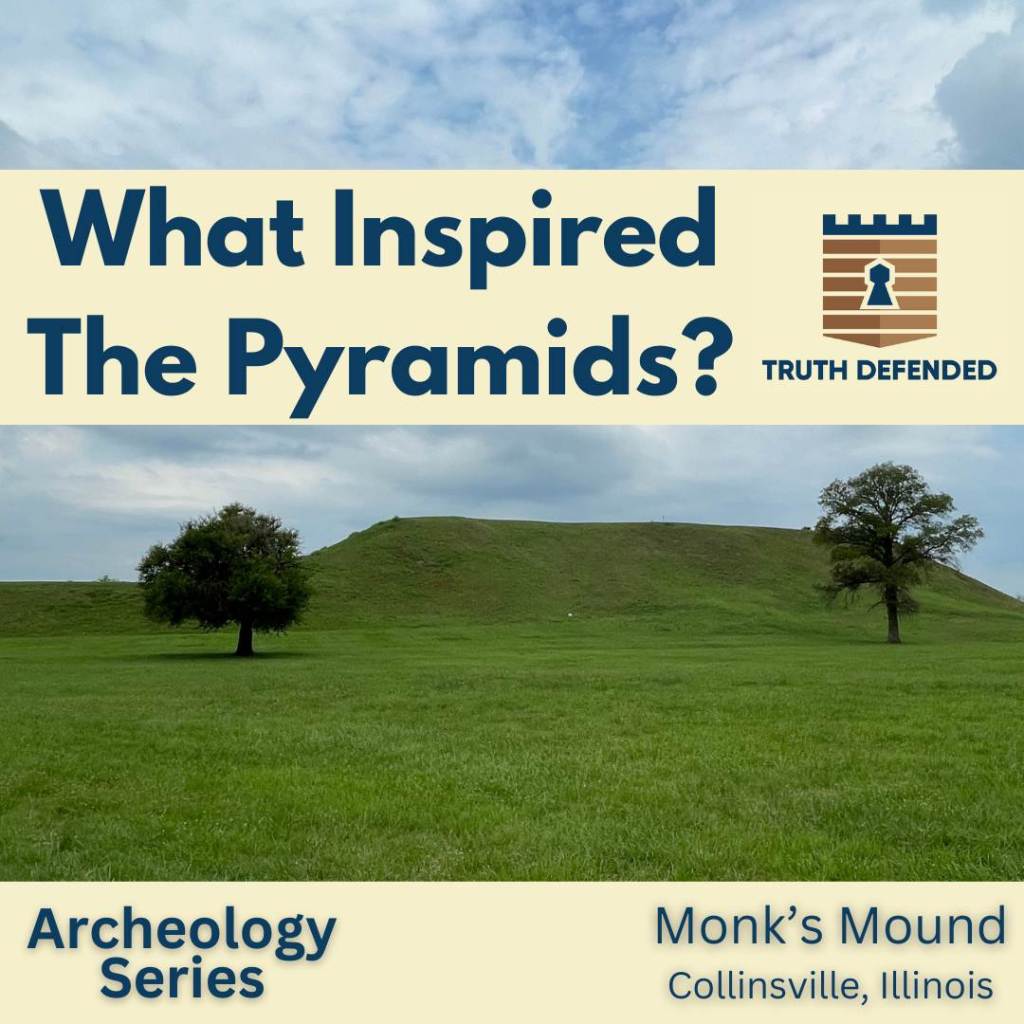
Just East of Saint Louis, MO., is a mound I hoped to visit one day. Recently, on a trip, I had a chance to explore it. The cover graphic for this post is one of the pictures taken on that visit. “Monks Mound” is part of a vast mound region called the Cahokia Mounds State Historic Site.[3] Monk’s Mound is said to be “the largest prehistoric earthwork in the Americas.”[4] Named after a group of Trappist monks who lived near the mound, the base of Monk’s Mound is “roughly equivalent to that of Khufu’s Great Pyramid in Giza.”[5] This earthen mound is colossal, though not nearly as tall as the Great Pyramid at Giza. Building with dirt instead of stone creates tremendous limitations for a structure, and erosion is a real problem when building with dirt.
The mounds around Monk’s Mound comprised dwelling places, community centers, and agricultural centers. It was a large ancient city. The Cahokia Mounds State Historic Site says,
One of the greatest cities of the world, Cahokia was larger than London was in AD 1250. The Mississippians who lived here were accomplished builders who erected a wide variety of structures from practical homes for everyday living to monumental public works that have maintained their grandeur for centuries.[6]
I believe pyramids, ziggurats, and earth mounds are attempts at towers to reach the heavens, and each is connected in the following ways:
- While built in various shapes such as triangles, circles, and squares, these structures were constructed vertically to reach the sky or heavens. Each tower was erected with dimensions and topography directing the humans upward in elevation.
- Humans constructed these towers, demonstrating feats of engineering. Massive amounts of time, energy, and hard human physical labor was invested in these buildings.
- These towers served various purposes, from celestial alignments to religious sacrificial offerings to a common rallying point among those who built them.
What inspired the stone pyramids, terraced ziggurats, and large earthen mounds worldwide? Why are there so many towers around this world in various cultures and continents? Is there a precedent or event that stirred a fascination with building tall structures reaching into the heavens? The answer to both these questions is “Yes!”
In the Book of Genesis, the first book of the Bible, the Lord shares an eyewitness account of the first tower building in the Middle East in Babylon. Genesis 11:1-9 states,
And the whole earth was of one language, and of one speech. And it came to pass, as they journeyed from the east, that they found a plain in the land of Shinar; and they dwelt there. And they said one to another, Go to, let us make brick, and burn them throughly. And they had brick for stone, and slime had they for morter. And they said, Go to, let us build us a city and a tower, whose top may reach unto heaven; and let us make us a name, lest we be scattered abroad upon the face of the whole earth. And the Lord came down to see the city and the tower, which the children of men builded. And the Lord said, Behold, the people is one, and they have all one language; and this they begin to do: and now nothing will be restrained from them, which they have imagined to do. Go to, let us go down, and there confound their language, that they may not understand one another’s speech. So the Lord scattered them abroad from thence upon the face of all the earth: and they left off to build the city. Therefore is the name of it called Babel; because the Lord did there confound the language of all the earth: and from thence did the Lord scatter them abroad upon the face of all the earth.
Genesis 11:1-9
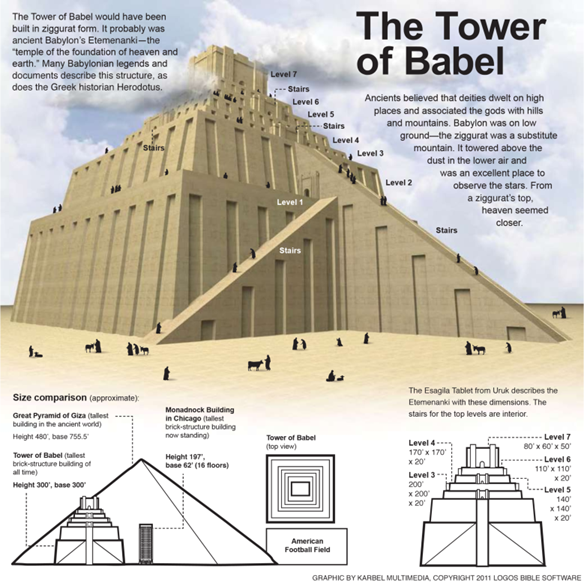
The biblical account of Babylon, the tower, and the resulting confusion and creation of languages present much information about why the earth is the way it is today. The origins of multiple languages, diverse ethnic and cultural people groups, and more were established after this first tower was built to defy God and form a man-centered religion. The pyramids, ziggurats, and mounds are all attempts at a tower reaching the heavens. The ancient buildings were erected following the stories orally passed down from generation to generation. After the original tower at Babel, the people groups traveled and settled in different locations worldwide, bringing this fascination with building a tower into the heavens along with them. Be sure to see the rendering of this tower at the bottom of this article.
On one final note, archeological evidence referencing and authenticating the Tower of Babel is found occasionally. For example, “In 2017, Aleteia’s (An online newspaper) Zelda Caldwell reported on a tablet that bore an image of the tower, along with an inscription that referenced it as the “Great Ziggurat of Babylon.”[8] This tablet is believed to describe a reproduction tower built by King Nebuchadnezzar of Daniel’s time period. The original tower was built centuries earlier, closer to the Flood of Noah’s day. After the dispersal of the people, some who remained in the area apparently utilized the bricks from the tower to build their own homes. Britannica claims that aerial photography has helped identify the tower’s location, saying, “The photographs show the tower’s square-shaped outline in the center of the city.”[9]
All this is to say that the Bible is accurate, and authentic archaeology adds validation to the claims of the Bible. What inspired the Pyramids and other towers found around the world? The biblical account of the Tower of Babel did.
[1] History.com. Accessed 8.1.24. https://www.history.com/topics/ancient-americas/pyramids-in-latin-america.
[2] Ohio History. Accessed 8.1.24. https://www.ohiohistory.org/visit/browse-historical-sites/serpent-mound/.
[3] UNESCO. Accessed 8.1.24. https://whc.unesco.org/en/list/198/.
[4] Ibid.
[5] Timothy Schilling. The Glenn A. Black Laboratory of Archaeology, Accessed 8.1.24. Bloomington, Indiana. file:///C:/Users/pasto/Downloads/jfa25.pdf.
[6] Cahokia Mounds Historic Site. Accessed 8.1.24. https://cahokiamounds.org/explore/.
[7] The Holy Bible: King James Version, Electronic Edition of the 1900 Authorized Version. (Bellingham, WA: Logos Research Systems, Inc., 2009), Ge 11.
[8] Aleteia. Accessed 8.2.24. https://aleteia.org/2021/11/07/discovery-of-biblical-mortar-hints-at-location-of-tower-of-babel.
[9] Britanica. Accessed 8.2.24. https://www.britannica.com/video/180010/Overview-Tower-of-Babel#:~:text=The%20Tower%20of%20Babel%20stood,boulevards%20and%20narrow%2C%20winding%20lanes.

Leave a comment