
Introduction
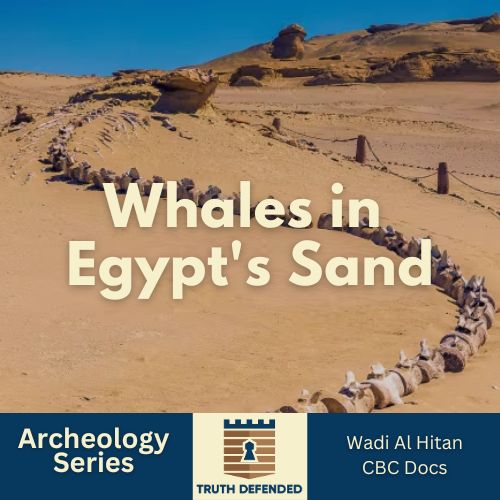
I recently came across some online photos of whale fossils in the middle of the Wadi Valley in the Sahara Desert in Egypt. These photos caused me to investigate further as this discovery piqued my interest in a Truth Defended article. These fossils in the Egyptian sands were first discovered in 1902.[1]
Wiki reports, “The fossils found at the site may not be the oldest, but their great concentration in the area and the degree of their preservation is such that even some stomach contents are intact.”[2] Whenever fossils are found with soft tissue, fluid, or stomach contents, it creates more interest in the mind of a scientist. There is more to study when the fossil includes those bonus features.
“379 fossil whales (179 catalogued) and 40 cataloged vertebrates” have been uncovered so far [3] Included among the larger whales we are familiar with today was a small whale previously unknown. Smithsonian Magazine reports, “a tiny, extinct whale that weighed only 410 pounds. The little creature grew just about eight feet long—or the size of a modern-day bottlenose dolphin.”[4]
According to UNESCO and their “World Heritage Convention,” these fossilized whales are evidence of whales being land animals before they walked into the sea. They say, “The globally important fossils of Wadi Al-Hitan (Whale Valley), in the Western Desert of Egypt, provide dramatic evidence of one of the iconic stories of evolution: the emergence of whales as ocean-going mammals, from their previous life as land-based animals.”[5] Indeed, their conclusions are inconclusive, and they assume something for which there is no objective evidence. Why would the whales sprout legs so far from shore? Why are no legs found on these fossils?
An Original Account
The origin of whales is described in detail in the Genesis account of the Bible. Genesis 1, penned by Moses, says,
And God said, Let the waters bring forth abundantly the moving creature that hath life, and fowl that may fly above the earth in the open firmament of heaven. And God created great whales, and every living creature that moveth, which the waters brought forth abundantly, after their kind, and every winged fowl after his kind: and God saw that it was good. And God blessed them, saying, Be fruitful, and multiply, and fill the waters in the seas, and let fowl multiply in the earth. And the evening and the morning were the fifth day (Genesis 1:20–23, KJV 1900).
According to the account God gave Moses, God spoke the world into existence, and on day five of the creative week, God created sea creatures with “great whales” explicitly mentioned. From nothing, God created everything. This concept is derived from the Latin “Ex Nihilo, ” meaning “out of nothing.” “Ex nihilo is a Latin phrase meaning “out of nothing” and refers to the concept that the universe (all matter and energy) was created out of nothing by a divine act.”[6]
From the Genesis account, we learn that God created the whales and that mankind knew a lot about them. Adam, the original man, even named the animals in Genesis chapter 2. So, how did the whales end up in the desert sand above sea level? Look at any Egyptian map and ask, “How can these fossils be located about 160 miles south of the Mediterranean Sea?”
What story do the whale fossils in the desert sands of Egypt really tell?
A Flood Was Coming
Noah was the man God instructed to build an ark. A flood was coming. Read his story in Genesis 6-8. When the flood came, and the rain poured for 40 days, the entire earth’s masses of land were covered. The Bible also described the “Fountains of the great deep” as broken up (Genesis 7:11), indicating sources of water underground gushing up. The geography and topography of the entire globe changed during the flood event. God was judging the earth for choosing evil over choosing the Lord. All sin will eventually be judged.
How can there be thousands of sea-going creature fossils in a desert? The global flood of Noah’s day is the answer. When the water rose, thousands of sea creatures explored the new areas above the land where the water rose. Large schools of fish and other sea creatures had more space to swim in. The flood waters surged around 20 feet higher than the tallest mountain, according to Genesis 7:20.
A Flood Recedes
Just like modern floods, the water eventually recedes and goes down. When the water recedes in Genesis 8:3, some fish, whales, and other sea creatures are left stranded in depressions on the earth. These depressions would be shallow ponds with just a tiny amount of water- for a while. When I was a teenager, the Scioto River and Ohio Rivers flooded. The corn fields in the lower Ohio Valley were flooded. After the rain and river surges, the flood receded. Once the water levels went down, we walked some fields and found several large fish in small puddles thousands of feet from the river’s shore. The puddles had dried up, and the fish roasted in the sun. When the global flood waters receded, the whales of the Wadi Al-Hitan were left trapped, where they eventually died, dried up, and were finally covered with the desert sand.
Conclusion
While not popular, the Bible narrative is not only plausible but is rooted in basic science and common understandings. The whale fossils in the Wadi Al-Hitan desert sands are evidence of the biblical narrative of the earth’s history.
- What do you think about these whale fossils?
- Do you have any fossils near your home?
[1] WIKI, Wadi Al Hitan, Wikipedia 2021. Accessed 9.12.24. https://en.wikipedia.org/wiki/Wadi_al_Hitan.
[2] Ibid.
[3] World Heritage Datasheet Wadi Al-Hitan, 2005. Accessed 9.12.24. http://world-heritage-datasheets.unep-wcmc.org/datasheet/output/site/wadi-al-hitan-whale-valley/#:~:text=The%20skeletons%20of%20four%20species,catalogued)%20and%2040%20catalogued%20vertebrates.
[4] Shi En Kim, “Fossil of Tiny, Extinct Whale Discovered in Egypt, Named for King Tut,” Smithsonian Magazine, August 11, 2023. Accessed 9.12.24. https://www.smithsonianmag.com/smart-news/fossil-of-tiny-extinct-whale-discovered-in-egypt-named-for-king-tut-180982709/#:~:text=Now%2C%20some%2041%20million%20years,area%20rich%20with%20whale%20specimens.
[5] UNESCO, Wadi Al-Hitan, UNESCO, 2024. Accessed 9.12.24. https://whc.unesco.org/en/list/1186/.
[6] Nathan Mahr, “Creatio Ex Nihilo,” Study.com, 1.29.2023. Accessed 9.12.24. https://study.com/academy/lesson/ex-nihilo-creation-story-origin-summary.html#:~:text=What%20does%20ex%20nihilo%20mean,such%20as%20Islam%20and%20Judaism.

Leave a comment