
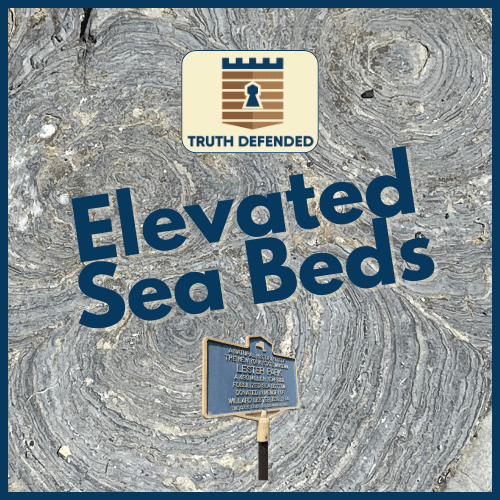
Sea beds are not only found on the ocean floor but in other, less likely places around the world. About a 10-minute drive from our home in Saratoga Springs, NY, is a geological park called “Lester Park.” In this beautiful location among the southernmost hills of the Adirondacks, the fossilized remnants of the ocean floor can be seen. This location is nowhere near the ocean, and it’s even at an elevation of 556 feet above sea level.[i]
The New York State Museum says, “You can walk on a 490 million-year-old tropical sea floor just northwest of Saratoga, New York. Lester Park, an outdoor exhibit, was donated to the Museum in 1914 as a “Scientific Reservation.”[ii] Looking at the ancient stromatolite fossils and the green-blue algae that have become stone is a spectacular example of the crushing weight and power of water. There are even a few snails, trilobites, and brachiopods to be seen at this site.
According to the National Park Service, fossils are “the remains or traces of organisms that were once alive. From the massive bones of dinosaurs to the delicate impression of a fern frond, fossils come in all shapes and sizes. Fossils that are the remains of an actual organism, such as a shell, leaf, or bone, are known as body fossils.”[iii]
Fossil Formation
With the right amount of pressure, fossils can be formed relatively quickly, but they must be buried in the mud speedily, or else the organic matter will decompose. The Australian Museum says, “Fossils are formed in many different ways, but most are formed when a living organism (such as a plant or animal) dies and is quickly buried by sediment (such as mud, sand or volcanic ash). Soft tissues often decompose, leaving only the hard bones or shells behind (but in special circumstances the soft tissues of organisms can be preserved).”[iv]
Interestingly, modern-day scientists are now able to replicate the fossil formation process, and a primary element in this process is water at high pressure, or PSI (Pounds Per Square Inch). In experiments conducted by the Foundation for Scientific Advancement, fossils were produced in 24 hours. Notice the following experiments and how they demonstrate it’s the pressure and conditions that are required more than time.
“Evan Saitta and Tom Kaye (of the Foundation for Scientific Advancement) “Used a hydraulic press to stuff various samples—like lizard limbs and bird feathers—into clay tablets with about the same diameter as a dime.”[v] Here is how they replicated fossils and sped up the process. “They baked the tablets in a laboratory oven at over 410 degrees Fahrenheit and 3500 psi—a pressure 300 times higher than the atmospheric pressure at sea level, according to Carlson (the writer of the Smithsonian article).”[vi]
Moving the Sea Floor Up a Mountain
As a land surveyor over 25 years ago, I frequently measured topography and elevation when creating property maps. The shape and contour of the land are interesting to me, especially when things appear to be out of place. How can the sea floor of years ago be on the top of a hillside 556 feet above sea level? How do fossils appear at such an elevation?
Theories abound as to how the global phenomenon of sea level fossils being so high on hillsides and in mountains around the world. The primary theory speculated by evolutionary theorists is that the Earth’s shifting tectonic plates and the terrain below sea level being pushed upward from the sea floor become the mountains of today. That certainly is a possibility in some specific locations.
The biblical theory, rooted in the historical narrative of Genesis, offers a feasible solution that does not require as much faith as the theories proposed by evolutionists. The great flood of Noah’s era is believed to explain the presence of fossils. I’ll give you three possibilities from Genesis.
- Genesis 7:7-19 records, “And the flood was forty days upon the earth; and the waters increased, and bare up the ark, and it was lift up above the earth. And the waters prevailed, and were increased greatly upon the earth; and the ark went upon the face of the waters. And the waters prevailed exceedingly upon the earth; and all the high hills, that were under the whole heaven, were covered.” The water, with its immense weight and pressure is above all the ground of the earth and along with the mudslides from this disaster, is creating “Billions of dead things layed down in rock layers covering the earth,” as Ken Ham of Answers in Genesis is known for saying. Therefore, the fossil formations discovered at high elevations today were formed in the same way as the fossil formations at lower elevations.
- A second biblical possibility is that when the flood began, the topography and geography of the Earth shifted, and much of what we see today was formed through tectonic shifts and the emergence of mountains from the sea floor. Genesis 7:11 says, “In the six hundredth year of Noah’s life, in the second month, the seventeenth day of the month, the same day were all the fountains of the great deep broken up, and the windows of heaven were opened.”
- A combination of floodwaters and the shifting of the earth could also result in the phenomenon of fossil formations at high elevations. Both scenarios are connected to the massive, global flood, of Noah’s day and either one or both provide a good explanation as to why and how there are fossils on hillsides and mountains around the world.
Historical and Eclectic Flood Stories
There are numerous stories of catastrophic floods found throughout various cultures around the world. Where did these stories come from? While the names and locations of the people and places of the story vary somewhat, they appear very similar to the original story found in the Bible. Noah and the flood of Genesis chapters 6-10. For example, historical writings from around the globe have flood stories. “Sixty-eight different peoples are known to have flood legends. Philo of Alexandria and early Christian apologists knew of a Greek flood story in which Deucalion is the hero, and some identified Deucalion with biblical Noah. Berossus, a Babylonian priest of Marduk writing in Greek about 275 b.c., produced an account of a flood whose hero is Xisuthros.”[vii]
Conclusion
It’s all a matter of perspective. The worldview one has adopted influences the way they interpret the data and evidence before them. While many may contend that Noah’s Flood is a myth, the evidence around the world, both geographically, topographically, and culturally, reflects the truth of God’s Word – God flooded the earth in judgment but provided a way for humanity to be rescued and saved. The Ark of Noah and his sons is a beautiful picture of Jesus Christ and the salvation from the judgment of sin that He provides to us. I encourage you to get on the Ark of Deliverance. Believe in Jesus Christ for your salvation.
Hebrews 11:7, part of the “Hall of Faith” chapter, which cites heroes of the Old Testament, mentions Noah. “By faith Noah, being warned of God of things not seen as yet, moved with fear, prepared an ark to the saving of his house; by the which he condemned the world, and became heir of the righteousness which is by faith.” The evidence from around the world regarding the global flood suggests that God will judge sin, but He also provides a way of escape. Get on the Ark.
If you have fossil beds near you, let me know. Send some pictures and information. If possible, I’ll visit those sites with you.
[i]TrailsNH. Accessed 5.29.25. https://trailsnh.com/hike/n/6721972180/Lester-Park-NY.
[ii] New York State Museum. Accessed 5.29.25. https://www.nysm.nysed.gov/research-collections/geology/resources/lester-park.
[iii] National Park Service. Accessed 5.29.25. https://www.nps.gov/subjects/fossilday/faq.htm
[iv] Australian Museum. Accessed. 5.30.25. https://australian.museum/learn/australia-over-time/fossils/how-do-fossils-form/
[v] Smithsonian Magazine. Accessed 5.29.25. https://www.smithsonianmag.com/smart-news/scientists-baked-fossil-24-hours-180969770/
[vi] Smithsonian Magazine. Accessed 5.29.25. https://www.smithsonianmag.com/smart-news/scientists-baked-fossil-24-hours-180969770/
[vii] Jack P. Lewis, “Flood,” in The Anchor Yale Bible Dictionary, ed. David Noel Freedman (New York: Doubleday, 1992), 798.

Leave a comment