

Written in 1943 during World War II, the song “I’ll Be Home for Christmas” offered comfort to many soldiers and their families. It beautifully expressed the hope of soldiers returning and the eager anticipation of loved ones at home. I enjoy the song each Christmas season too.
In a similar spirit of homecoming, the prophet Malachi writes about Jesus’s return. Malachi 3 describes a messenger, John the Baptist, who will prepare the way for the Lord’s sudden arrival at “his temple.” This vision parallels a soldier’s return from war, with Jesus coming back to his rightful place.
God’s presence was revealed by the cloud that filled Moses’s tabernacle and later Solomon’s temple. However, following Solomon’s time, there is no indication of this divine presence in the temple again—until Jesus’s arrival.
Jesus was first brought to the temple as an infant. There, the prophetically gifted Simeon praised God upon seeing “the salvation of God” (Luke 2:32). Thirty years later, Jesus walked into the temple and drove out the greedy money-changers who were defiling the “house of prayer” (John 2). He repeated this cleansing near the end of his ministry (Luke 19).
Commentator John Phillips notes that Malachi also foresaw this coming. By Jesus’s time, Herod had enlarged the temple, yet it remained a place of sin. The priests had turned the Court of the Gentiles into a profitable market for selling sacrificial animals, while money-changers conducted their business.[1]
Although Jesus’s two cleansings provided a glimpse of his future judgment, they were not the full realization of Malachi’s prophecy. Malachi primarily referred to the future judgment, as seen in this powerful prophecy:
“Behold, I will send my messenger, and he shall prepare the way before me: And the Lord, whom ye seek, shall suddenly come to his temple…He shall come, saith the LORD of hosts” (Malachi 3:1).
Read the rest of Malachi 3:1-6 and you will discover Jesus is cleansing with soap and purifying the priests and the people with a refiners fire like what a goldsmith or silversmith does with precious metal. Jesus will clean up his people for the Millinial Kingdom.
Malachi’s vision “skips” over the Church Age, moving directly from John the Baptist to the Lord’s coming and subsequent judgment. The earthly ministry of Jesus and the 2,000 years since are not depicted. As the radio preacher J. Vernon McGee explained, “This is His coming not in grace, not as a Redeemer, but as a Judge… to establish His Kingdom.”[2] This is like viewing distant mountaintops without seeing the valley in between. Malachi does not see the “Church Age” that we are living in. This space of grace was not known to Malachi, but he did give us a glimpse of the future with Jesus.
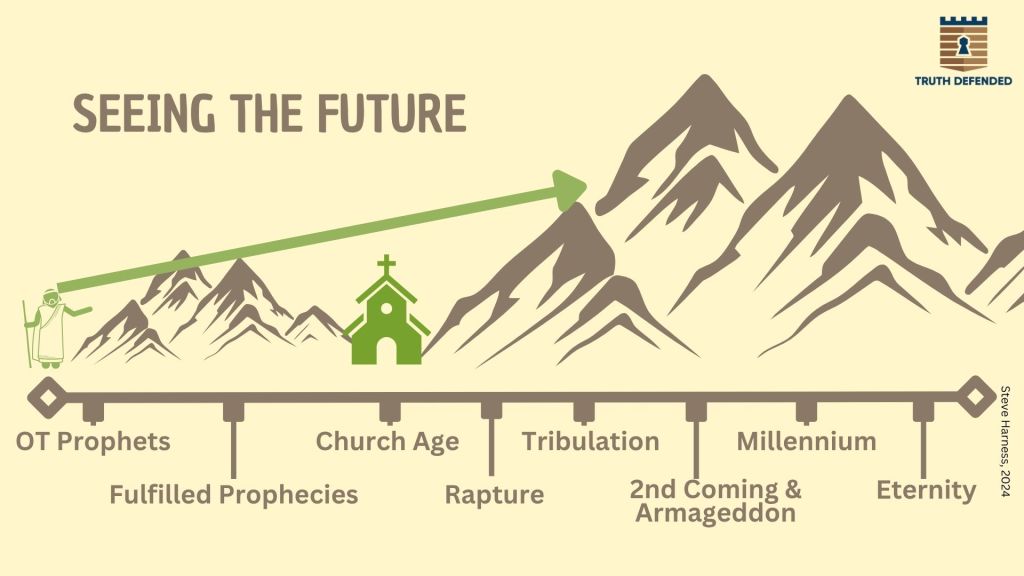
Following the Tribulation, Jesus will return to the temple to establish his 1,000-year Millennial Kingdom. He will cleanse the temple that the Antichrist desecrated (Mark 13:14). During this time, the still-sinful human population will rebel again, led by Satan after his release from Hell. Jesus will defeat them, and Satan will be cast into the Lake of Fire forever (Revelation 20).
While Malachi’s prophecy points toward this future cleansing at the start of the Millennial Kingdom, it also alludes to Jesus’s first arrival.
This holiday season, as we celebrate Christmas, we should remember that Jesus will one day return to Earth, not in peace, but in judgment and cleansing. Let us celebrate our salvation, thank Jesus for his first coming to pay for our sins, and then worship our living God, who will one day return for his followers and a few years later, his temple.
Merry Christmas!
[1] John Phillips, Exploring the Minor Prophets: An Expository Commentary, The John Phillips Commentary Series (Kregel Publications; WORDsearch Corp., 2009), Mal 3:1a–b.
[2] J. Vernon McGee, Thru the Bible Commentary: The Prophets (Malachi), electronic ed., vol. 33 (Nashville: Thomas Nelson, 1991), 69.

Leave a comment