

The question of how God’s sovereign will and human volition interact is one of the most enduring debates in the Christian faith. Some argue that God’s will effectively overrides human choice. While an omnipotent God certainly possesses the power to do so, the biblical narrative suggests an incredible alternative: He graciously allows individuals the dignity of their own choices.
This tension is most visible in the context of salvation. Does a person place their faith in Jesus of their own volition, or does God ordain and control the outcome, essentially necessitating a positive response to the Gospel? To explore this, we must first establish three key definitions:
- God’s Sovereignty: His absolute and unrivaled rule over all creatures and circumstances.[1]
- Free Will: The capacity to determine one’s own acts or courses of action.[2]
- Compatibilism: The view that God’s ultimate plan is fulfilled through human choices, rather than in spite of them.[3] In this framework, sovereignty and free will work in a consistent, though mysterious, harmony.
The Two Sides of the Coin
In Philippians 2:12-13, the Apostle Paul captures this synergy: “Work out your own salvation with fear and trembling. For it is God which worketh in you both to will and to do of his good pleasure.” Notice the dual action: the individual is commanded to “work out” their salvation (human responsibility), yet it is God who is “working in” that same individual (divine sovereignty). The faithful Christian practices the life of faith while God simultaneously forges their character. In this sense, sovereignty and free will are two sides of the same coin—the coin being the human experience. Both wills converge to reach a final, divinely intended outcome.
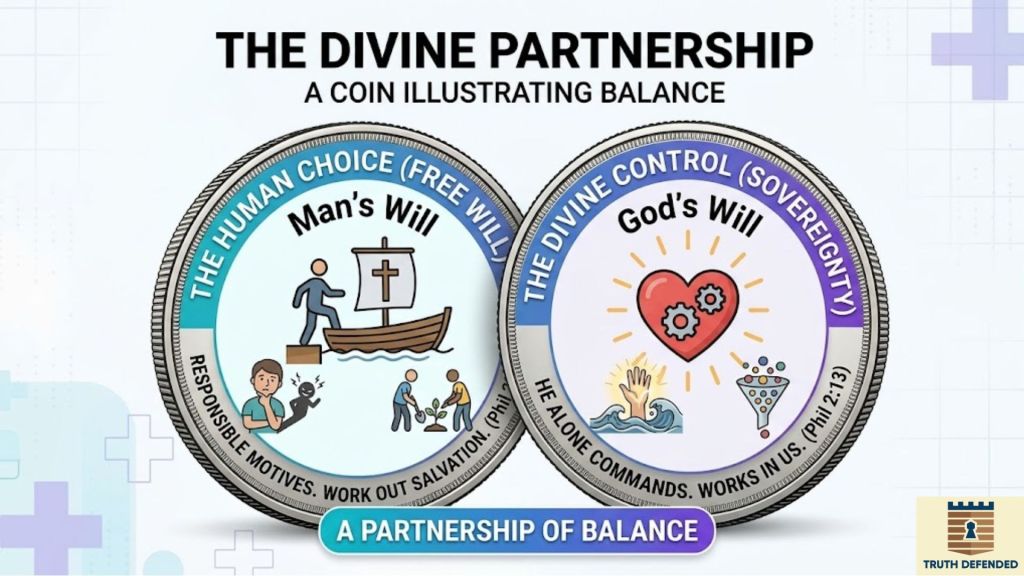
Three Examples of Divine-Human Convergence
To understand this balance, we can look at three pivotal moments in Scripture:
- The Storm (Luke 8:22-25): The disciples chose to board the boat to follow Jesus. Simultaneously, God sent a storm that threatened to sink them. Because the disciples exercised their will to follow Christ, they were positioned to experience both the danger of the storm and the subsequent life lesson when Jesus rebuked the wind and questioned their faith. Both wills were accomplished in the same moment.
- The Crucifixion (Acts 2:23): Preaching at Pentecost, Peter declared that Jesus was “delivered by the determinate counsel and foreknowledge of God,” yet he also charged the crowd with having “crucified and slain” Him by “wicked hands.” God determined from the beginning (Genesis 3:15) that Jesus would die for the world, yet the actors at Golgotha chose their rebellion. Humans provided the rebellion; God provided the redemption.
- The Life of Joseph (Genesis 50:19-20): Joseph famously told his brothers, “You thought evil against me; but God meant it unto good.” Driven by malice and envy, the brothers exercised their will to sell Joseph into slavery. This set off a chain of events—false accusations, imprisonment, and eventually, Joseph’s elevation to second-in-command of Egypt. This historical reality is supported by archaeology in Avaris (modern-day Tell el-Dab’a), where a tomb featuring a small pyramid and a statue of a Semitic official suggests Joseph’s high-ranking position.[4] While the brothers acted with hatred, God was orchestrating the salvation of a nation from famine.
The Purpose of Election
Romans 9 is often cited to suggest that humanity has no choice, specifically the phrase: “Jacob have I loved, Esau have I hated” (v. 13). However, this passage describes God choosing a lineage to be His representatives to the world. Just as the Church today represents the Gospel, God chose the Old Testament Jew to reveal His character to the nations. Similarly, when God “raised up” Pharaoh (v. 17), He was using a man’s existing stubbornness to create an opportunity to display His power and deliverance.
The Motivation: Authentic Love
Returning to our opening question: Does a person respond to salvation by choice, or does God choose for them? The answer is found in the nature of motivation.
God chooses to love us despite our sin, and He desires that we freely love Him in return. If love is coerced, forced, or “programmed,” it ceases to be genuine love. God did not send Jesus to demand the submission of robots; He sent Jesus to willingly lay down His life as an act of love. Ultimately, God provides the grace, but the individual retains the profound responsibility to either accept or reject the Savior.
“And if it seem evil unto you to serve the Lord, choose you this day whom ye will serve; whether the gods which your fathers served that were on the other side of the flood, or the gods of the Amorites, in whose land ye dwell: but as for me and my house, we will serve the Lord.”
(Joshua 24:15)
“The Lord is not slack concerning his promise, as some men count slackness; but is longsuffering to us-ward, not willing that any should perish, but that all should come to repentance.”
(2 Peter 3:9)
[1] Layton Talbert, “God’s Sovereignty over Creation,” in Lexham Survey of Theology, ed. Mark Ward et al. (Bellingham, WA: Lexham Press, 2018).
[2] George C. Watt and J. C. Lambert, “Free Will,” in A Dictionary of Christ and the Gospels: Aaron–Zion, ed. James Hastings (Edinburgh; New York: T&T Clark; Charles Scribner’s Sons, 1906), 621.
[3] The Baker Compact Dictionary of Theological Terms, Allison, Gregg R., Baker, 2016.
[4] https://armstronginstitute.org/835-the-hyksos-evidence-of-jacobs-family-in-ancient-egypt

Leave a comment