
Introduction
The term “Gospel” is perceived as the death, burial, and resurrection of Jesus.[1] While the crucifixion and resurrection of Jesus is paramount to the Gospel, it is only part of the broader story. Theologian Scot McKnight says the Bible is the story of Israel and of Jesus, demonstrating the Gospel is deeper and wider than the central point of the crucifixion and resurrection. Salvation, purchased at the Cross, is humanity’s focal point. Indeed, the Gospel includes personal salvation (forgiveness of sins, gift of eternal life), but there is more to the biblical meta-narrative[2] and the Gospel in particular. This writing will present the Gospel as a unified big story, creating a more accurate representation of the Gospel by using Scripture and identifying what the Gospel is not and what the Gospel is while explaining it with practical and theological applications. I propose the Gospel primarily about relationship.
The Gospel Defined
What the Gospel Is Not
When asked to define the Gospel, many suggest 1 Corinthians 15:1-11 to find their answer, and that is an excellent place to begin, but it only tells part of the whole. The Apostle Paul tells the Corinthians how to believe (πιστεύω) the salvation Gospel and obtain salvation by trusting in the message Paul received. Paul received and believed this resurrection good news (delivered to him in creed form[3]) personally and shared the message with others. The Gospel messages delivered by Peter and Paul in the book of Acts, in addition to the four Gospels, Matthew, Mark, Luke, and John, form a more complete picture of the Gospel. The term “Gospel” is the Greek word εὐαγγέλιον (euaggelion), which means “good tidings” or “good news.”[4] Matthew Bates summarizes, “Euangelion refers to glad tidings heralded forth, a happy message publically announced and proclaimed.”[5] Common words among Christians such as “evangelicalism” and “evangelism,” also come from this Greek term, “euangelion.”[6] What is the “Good News” of the Gospel?
To further clarify the Gospel, we begin with what the Gospel is not. It is not salvation only, nor is it the only Gospel available today.
- The Gospel is Not Salvation Only.
Salvation is a part (an important part) of the more extensive term “Gospel.” Scot McKnight observes, “We evangelicals (mistakenly) equate the word gospel with the word salvation. Hence, we are really “salvationists.” When we evangelicals see the word Gospel, our instinct is to think (personal) ‘salvation.’”[7] Sharing a “plan of salvation” is not the same as sharing the Gospel. For many years, I have preached a modified or partial “Gospel of salvation.” It goes like this:
- You are a sinner.
- Jesus shed His blood and died for your sin.
- Jesus rose from the dead the third day.
- Jesus ascended into Heaven.
- You can believe in Jesus, be saved and forgiven of your sin, and go to Heaven one day.
The example above is a Soterian[8] view of the Gospel. It is a “plan of salvation” but is not the complete Gospel. Many people come to believe in the resurrection of Jesus when they claim this plan of salvation for their own, but they may not fully grasp the Gospel in its entirety because they have not been relayed the full story of the Gospel. How did many become “Soterian Preachers” instead of “Gospel Preachers?”
Scot McKnight explains how this Soterian perspective may have replaced the more complete Gospel. He makes historical highlights from Martin Luther and the Reformers to the Geneva Confession, John Wesley and the Methodists, to revivalists Jonathan Edwards and George Whitfield. The preaching of Edwards and Whitefield saw many come to faith in Christ and made a long-term impact on early American society in what is known as “The First Great Awakening.”[9] However, the seeds of Soterian theology replacing the whole Gospel were sown in the soil of a conversion experience. Conversion became more important than becoming a true disciple. McKnight writes, “When that conversion experience became the necessary requirement for admission into heaven and in some ways into one’s local church, the soterian gospel came into its own.”[10] This observation highlights that raising hands, moving forward to pray, or confessing a decision became a goal for many churches and ministers. Fast forwarding through the years to Charles Finney (who it is said to have invented the “invitation”[11]) and D.L. Moody, the revivalist preachers of the 1800’s led many people to faith in Jesus in their revival meetings, which included wholesale change of communities, churches, families, and individuals. From Moody came subsequent generations of preachers: Wilbur Chapman, Billy Sunday, and then Mordecai Hamm. Hamm was preaching when Billy Graham responded to salvation. It is said of Mordecai Hamm he “would preach for weeks in a given location before giving people an opportunity to receive Christ.”[12] He delayed an invitation to salvation and allowed space for the Spirit of God to convict souls of sin. This delay garnered more than merely an emotional response; it resulted in real life change with genuine conversion and discipleship.
Billy Graham effectively popularized the Soterian view when presenting the Gospel and bringing his message to the masses. Along with Graham, Bill Bright of Campus Crusade for Christ, Henrietta Mears of Hollywood Presbyterian Church (and founder of The National Sunday School Association), James Kennedy of Evangelism Explosion, and the printing and use of gospel tracts,[13] all presented a concise salvation message. The Gospel was reduced to short messages and was even miniaturized to fit on a small piece of paper (Gospel tracts). As a method, the plan of salvation was conveyed more often than the entirety of the Gospel. An example is “The Romans Road.” McKnight writes, “The gospel of the mid-twentieth century reduced the Reformation’s soteriology into four or five crisp claims, bundled it all into a powerful, decision-generating order, and created ‘Christians.’” While a worthwhile goal to see people trust Christ, this disproportionate emphasis has created many shallow Christians who are not yet fully committed disciples of Christ. Too many claim Jesus is their Savoir, but have no evidence or fruit validating that claim.
For the record, my grandparents, who never owned a vehicle, walked anywhere they went, watched on a small black and white TV their “TV Pastor,” Billy Graham, often and confessed Jesus as their Savoir, for which I am thankful. Is there a better way of communicating the entire Gospel?
The alternative to merely seeing people “saved” is to see them become “disciples of Christ” by becoming genuine followers and growing in their relationship with Him. Jesus speaks often of making disciples, not simply making converts. In the Great Commission of Matthew 28:19-20, Jesus instructs, “Go ye therefore, and teach all nations, baptizing them in the name of the Father, and of the Son, and of the Holy Ghost: Teaching them to observe all things whatsoever I have commanded you: and, lo, I am with you alway, even unto the end of the world. Amen.” The word “teach” is μαθητεύω (mathēteuō) which means “to be a disciple, to make a disciple.”[14] In other words, disciples are to “make disciples.” The discipleship is conducted through “teaching” διδάσκω (disdasko) which means “to hold discourse with others in order to instruct them.”[15] The Great Commission implies these new disciples are eager to learn the ways of their new Lord and Savoir, Jesus. Donald Whitney lists helpful practices for converts to become genuine disciples of Christ. He says, “If people have the truth in their heads but not in their hearts (that is, they know the truth but do not believe it and experience its power) then they are not right with God.”[16] These believers are not experiencing fellowship with God in their relationship with Him. It’s like they are avoiding Him. Spiritual disciplines are helpful components of practicing disciples.
Born-again Christians are not to stop at salvation only but go on to become true disciples of Jesus. Dallas Willard does not settle for Soterian Theology only for church Gospel ministry. He declares, “If there is anything we should know by now, it is that a gospel of justification alone does not generate disciples. Discipleship is a life of learning from Jesus Christ how to live in the Kingdom of God now, as he himself did.”[17] The Gospel is more than salvation only.
- The Gospel is Not the Only Good News Available.
The Good News comes in many forms. The Roman Empire dominated the world when Jesus came to earth at the incarnation, and it presented a nationalistic gospel. Matthew Bates relates, “For the Christian Gospel was not the only good news being promulgated. The Roman emperors were busy spreading their own version of the good news. The emperors… were increasingly taking on divine claims and prerogatives for themselves.” [18] The concept of other Gospels is evident while watching the news, walking at the mall, or attending school. Worldviews are other “Good News” options many look to for salvation, including individualism, consumerism, nationalism, scientific naturalism, and new age. Steve Wilkens and Mark Sanford clarify, “All worldviews are ultimately about salvation, even if they don’t use that vocabulary.”[19] In the time of Christ and when Paul was preaching the Gospel, the Roman Emperor would describe himself as the Savoir. “The term kyrios, “lord,” along with sōtēr, “savior,” was a favored term used by the emperor.”[20] His “good news” is an example of nationalism. There are many “gospels” available today.
The Gospel is not “salvation only” nor the only “gospel” available. What is the Gospel?
What the Gospel Is
The Old Testament Law (Exodus 20, Deuteronomy 6, Romans 2:23, James 2:10) provides evidence of humanity’s need for salvation found in relationship to God the Father through God the Son (1 Timothy 2:5). Sin separates humanity from God, as illustrated in the Garden of Eden, with Adam and Eve hiding from the Lord following their transgression (Genesis 3). Eve was deceived while Adam willfully disobeyed the Lord’s single command Romans 5:12). Darrel Bock elaborates on sin, “Even as Jesus suffered for sin, even as He showed how egregious sin was in the drama of salvation, the ultimate goal was not to convince people that they sinned but to point the way to God.”[21] Bock is correct in several ways: (1) Sin introduced suffering and death to this world, (2) The “God-consciousness” within us convinces us of our sinfulness (John 16:8), (3) the Old Testament Law proves our sin, and, (4) a blood sacrifice is required as a penalty for our sin. These factors cause humanity to see the need for a relationship with God through His Son.
- The Gospel is Relationship.
In John 10:27-30, the Father/Son combo establishes a relationship with His people, the sheep. The Good Shepherd comes to lay down His life for His sheep (John 10:15). God the Father sent His preexistent (John 1:1-3) Son Jesus to this world to save us from our sins (John 3:16). Bock notes the active nature of God displaying His love for us; “God has taken the initiative in Jesus Christ to bring us into relationship with Him.”[22] The relational covenants and creeds of the Old Testament are conveyed often and find their fulfillment in the New Testament in the person of Jesus: (1) Jesus is the embodiment of the good news (John 1). (2) Jesus is the “seed of the Woman (Genesis 3:15). (3) Jesus is the perfect sacrifice (Isaiah 53:7, 1 Peter 1:19). Mark Boda elaborates, “While Yahweh is clearly the initiator in the relationship, the people’s response is essential.”[23] God’s people responded to the creed that God initiated. These Creeds include Deuteronomy 26:16-19, Exodus 19-20, Genesis 15, Psalm 2, Jeremiah 31-32, and Ezekiel 37:23.
From Genesis, we find Adam and Eve in a relationship with God, walking and talking in the Garden. However, sin destroyed this fellowship (Genesis 3). While still “children of God,” their relationship is strained. Sin put a pause on their fellowship and communion with God. Continuing in history, the Father of many nations (including Israel), Abraham, was called the “Friend of God” in James 2:23, indicating a healthy relationship. Jacob is invited to interact with God on several occasions at Bethel (בֵּֽיתְאֵל), “House of God,”[24] and this is the place where God appears to him and changes his name from Jacob to Israel (Genesis 35:9-10). God was bringing Jacob into His house and was planning for Israel to be His people and for Him to be their God.
While speaking to Moses and the recently redeemed Hebrews from slavery in Egypt, God confirms His goal of relationship. Exodus 6:7 is an early Hebrew creed stating, “And I will take you to me for a people, and I will be to you a God: and ye shall know that I am the Lord your God, which bringeth you out from under the burdens of the Egyptians.” Mark Boda realizes this statement as creed and says, “It expresses the status of those who once were not part of a family unit who have attained that status through agreement.”[25] This agreement from God with His people is essential on several fronts. (1) It describes the nature of the relationship. (2) It demonstrates total acceptance on God’s part for His people. (3) It conveys forgiveness of sins. (4) It provides deliverance from bondage. Such is the case with the fulfillment of Jesus and His redemptive mission in the Gospel (1 Thessalonians 1:7).
David, who later became King of Israel, had a close relationship with God. David had a heart after God’s own heart (1 Samuel 13:14). David lived with values and passions similar to the Lord’s and was even promised a son on the throne of an eternal kingdom. When Jesus sets up His future Kingdom, He relates to us as King and Lord.
When Jesus arrived on earth in His first coming, He established relationships with people. From the first twelve disciples to the one hundred twenty followers in the Upper Room and all the rest of the disciples to follow, He connected in caring, compassionate, and relational ways. The four Gospels clearly articulate Jesus’s loving relationship with people.
In the future, Jesus establishes His relationship as King and will return to earth and set up His Millennial Kingdom. Following this, Revelation 21-22 reiterates the relationship by declaring, “He that overcometh shall inherit all things; and I will be his God, and he shall be my son (Revelation 21:7). The Bible then concludes with an invitation. “And the Spirit and the bride say, Come. And let him that heareth say, Come. And let him that is athirst come. And whosoever will, let him take the water of life freely” (Revelation 22:17). God wants to be our God, and His people want to be His people in an ongoing relationship.
2. The Gospel is Restoration.
In broad terms, from origination to conclusion, the Bible reveals restoration as another goal of the Gospel. Restoration is demonstrated in several ways: (1) Restoring fellowship with God. (2) Sinlessness is restored when the fallen cosmos is replaced with a New Heaven and New Earth. (3) Kingdom life is restored. Jesus, when speaking to John the Baptist’s disciples, refers to the Kingdom being restored, and His words reflect Isaiah 29:18–19; 35:5–6; and 61:1.[26] (4) Life becomes eternal instead of temporal (Romans 6:23). The brokenness of humanity is restored and resolved in Jesus, His forgiveness, and His re-creation of a new heaven and earth restored in their perfection and beauty.
3. The Gospel is Reconciliation.
Romans 8:1 is one of many passages describing the Christian as being “in Christ.” Bock writes, “When we are in Christ, we pursue this reconfigured life in a fellowship with God that has Him on an open line.”[27] The reconfiguration he is speaking of includes a new way of living and internal peace. Because the Christian is “in” Christ, he is reconciled to God the Father. His sins are accounted for and paid for by Jesus Himself. The relationship and restoration of the Christian is fully realized in this reconciliation (2 Corinthians 5:18). The Apostle Paul “points to a key event in the NT narrative creed (resurrection) as essential for Christian faith.”[28] Through this resurrection, relationship, restoration, and reconciliation are possible because the Gospel is the “power of God unto salvation” (Romans 1:16).
The Big Story Explained
To explain the Gospel in its big story narrative to individuals in personal conversation, I suggest the following elements from Biblical scholar Kaz Yamazaki-Ransom. He proposes a comprehensive seven-part model of the Gospel in his article, “Putting the Bible Together.” These elements are:
- Creation (A)
- Origin of Evil (B)
- People of God (Israel) (C)
- Jesus (X)
- Renewed People of God (Church) (C’)
- Defeat of Evil (B’)
- Renewed Creation (A’)[29]
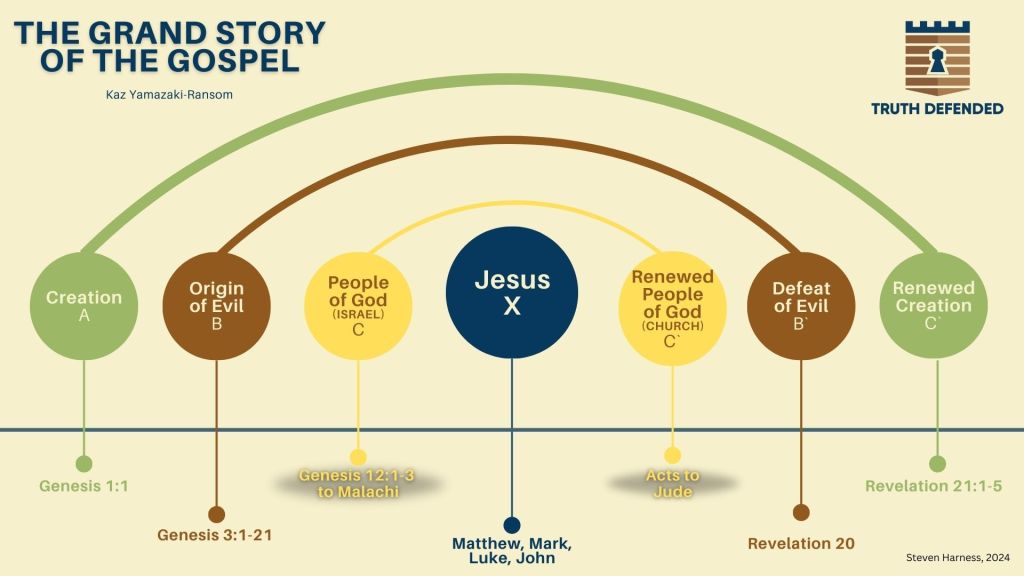
Conversely, many see sin and evil as a significant problem in this world. They yearn for an answer to the problems that surround them. The meta-narrative starts with creation (A). God created a perfect world, but sin was introduced by the first man, Adam (B). Sin disrupted nature, and humanity created in God’s image is now marred with sin. The logical narrative of the first man’s sin and its consequences being passed down to subsequent generations makes sense. The promises to Israel (C) demonstrate God’s loving-kindness and reveal in smaller stories His larger redemptive goal in sending Jesus (X). Here, one can discuss the relevance of the life of Jesus and share how His perfect sacrifice defeated sin, and its consequences. Share hope with the resurrection and the promise of His coming again. In the end, Satan and all evil are defeated (B). A day comes when God renews His creation with a New Heaven and Earth. The above outline is essential to a more complete Gospel presentation. While these ideas may be new to the hearer, their magnitude, viability, and reasonableness will cause them to pause and consider. The Big Story explains to them the source of the problems of sin and the solution to sin, Jesus, all presented in the full context of the Gospel.
The Theology of the Gospel Applied
This course of study has further clarified my understanding of the vitality of personal discipleship following one’s conversion because of the call of God to “make disciples” and not merely make converts. The practice of church ministry in pursuit of the number of people attending or the number of “decisions for Christ” is not nearly as important as making genuine disciples of Jesus with long-term training and authentic spiritual formation desired by the new convert. While we are “fishing for men” (Mark 1:17), we are also bringing them into the boat of discipleship (Matthew 28:19-20) with orthodox methods of teaching, visible life change, and personal example. We are lifelong learners of Christ. Dallas Willard accurately describes Christian holiness and the importance of regaining Christ as the teacher by listing three essential discipleship elements: conviction of sin, conversion to a faithful (godly) life, and testimony to God’s saving work in the soul.[30] These elements are not forced on others but are lived so that the Spirit of God speaks to the new convert. Mature Christians cannot manipulate others to grow and change but can lead by example.
Here are several practical dimensions of the Theology of the Gospel.
1. Become the Gospel. Gorman contends, “Paul wanted the communities he addressed not merely to believe the gospel but to become the gospel.”[31] The evidence is clear from church to church that many profess a salvation decision but then do not show up to church again, are not baptized, and do not produce a life reflecting a life lived like Christ. “Becoming” refers to the process and spiritual formation that takes place with methodical learning processes (Deuteronomy 6, Isaiah 28:10-13). Spiritual disciplines are not an end of themselves, but when practiced with the right motivation and genuine affection for Christ, one can become more like Jesus. When a new convert grows in Christ (2 Peter 3:18), his life will yield humility and sacrifice (Philippians 2:1-8, Romans 12:1-2).
Belief in Christ for salvation and personal allegiance to Christ are needed to “become the Gospel.” Bates describes the faith required to become the Gospel as “allegiance.” He says, “Jesus’s reign as Lord of heaven and earth fundamentally determines the meaning of ‘faith’ (pistis) as ‘allegiance’ in relation to salvation.”[32] The genuine disciple of Christ will begin a journey to become the Gospel by demonstrating a life of faith and allegiance to Jesus. Some converts lie to themselves and others about their faith, while their lives indicate a lack of conversion. I see the practical value of Matthew Bate’s teaching that faith (pistis) sometimes indicates allegiance. However, I refute “Lordship Salvation” for the following reasons. (1) Grace demands salvation to be freely transacted. (2) Believing in Jesus is the start of a life of submission, but this is a lifelong concept known as sanctification. (3) No one can perfectly submit to King Jesus while on this sinful earth. I agree with Bate’s statement that a disciple is on: “a trajectory of loyal obedience.”[33] A growing disciple is learning obedience to Christ, setting his focus in that direction.
2. Live the Gospel. Missionaries are not the only ones called to share the Gospel. Life allows Christians to share Christ in action, attitude, and words. We can live a life shaped by the Cross. This cross-shaped life or “Cruciformity” is also called “Theosis.” Gorman shares, “The present life of cruciformity is a process of transformation that culminates in the final goal of conformity to the already-glorified Christ.”[34] He says, “The cross is the interpretive, or hermeneutical, lens through which God is seen; it is the means of grace by which God is known.”[35] One can live the Gospel like Jesus with the same humility and sacrifice. Gorman continues, “Theosis… is helpful language to describe the reality of participation in the life and mission of God, and thus becoming like God; Paul’s notion of theosis, or transformative participation, is inherently missional.”[36] We live the Gospel more authentically when we “die to self” (Galatians 2:20 and Romans 6:1-6).
3. Engage with the Gospel. The more a disciple of Christ is transformed by the Gospel, the better picture of Christ he becomes. Boda teaches, “The church should not be fleeing from creation and culture but rather engaging it, transforming it, and leading the way as image bearers of God. As restored image bearers, we are enabled to enjoy God’s creation and explore human culture as no one else on earth.”[37] I agree because we are the only “Jesus” some will ever see. Our collective and local church culture, family culture, and personal culture must express the “Imago Dei” in brighter and more articulated demonstrations of the fruit of the Spirit, “love, joy, peace, longsuffering, gentleness, goodness, faith,meekness, and temperance” (Galatians 5:22-23). Donald Whitney aptly states, “Without holiness—that is, Christlikeness or godliness—no one will see the Lord, regardless of how many times they have been to church or how often they have engaged in religious activities or how spiritual they believe themselves to be.”[38] Hebrews 12:14 says, “Follow peace with all men, and holiness, without which no man shall see the Lord.” The example of a Christian engaging life with the Gospel at the forefront is a powerful picture and illustration to others to believe in the Jesus of the Gospel as their Lord and Savoir. The result is the opportunity to become a Christian and continue as a disciple with an ongoing relationship with Jesus.
Conclusion
This paper has identified the Gospel in biblical terms, creating a more accurate representation of the Gospel by identifying what the Gospel is not and what the Gospel is and concluding with the big story explained along with practical and theological applications of the Gospel. We have identified how present-day evangelicalism has adopted a concise Soterian view of the Gospel while using Scripture throughout to see the big story of the Gospel. My goal from this course of study is to present in personal conversations and public ministry a more accurate portrayal of the entire Gospel of the Lord Jesus Christ in both my words and actions. God restoring and reconciling relationship with humanity is the goal of the Gospel. The Gospel is about relationship.
Bibliography
Bates, Matthew W. Salvation by Allegiance Alone: Rethinking Faith, Works, and the Gospel of Jesus the King (Grand Rapids, MI: Baker Academic: A division of Baker Publishing Group, 2017).
Bock, Darrell L. Recovering the Real Lost Gospel (Nashville, TN: B&H, 2010).
Boda,Mark J. The Heartbeat of Old Testament Theology: Three Creedal Expressions, ed. Craig A. Evans, Acadia Studies in Bible and Theology (Grand Rapids, MI: Baker Academic: A Division of Baker Publishing Group, 2017).
Brown, Francis., Driver, Samuel Rolles., and Briggs, Charles Augustus, Enhanced Brown-Driver-Briggs Hebrew and English Lexicon (Oxford: Clarendon Press, 1977).
Gorman, Michael J. Becoming the Gospel: Paul, Participation, and Mission, ed. John R. Franke, The Gospel and Our Culture Series (Grand Rapids, MI; Cambridge, U.K.: William B. Eerdmans Publishing Company, 2015).
Gorman, Michael J. Cruciformity: Paul’s Narrative Spirituality of the Cross (Grand Rapids, MI; Cambridge, U.K.: William B. Eerdmans Publishing Company, 2001).
McBeth, H. Leon. The Baptist Heritage: Four Centuries of Baptist Witness (Nashville TN: B&H Publishing Group 1987) Kindle Edition.
McKnight, Scot. The King Jesus Gospel: The Original Good News Revisited, Revised Edition. (Zondervan, 2016).
Thayer, Joseph Henry. A Greek-English Lexicon of the New Testament: Being Grimm’s Wilke’s Clavis Novi Testamenti (New York: Harper & Brothers., 1889).
Thomas, Robert L. New American Standard Hebrew-Aramaic and Greek Dictionaries: Updated Edition (Anaheim: Foundation Publications, Inc., 1998).
Whitney, Donald S., Spiritual Disciplines for Christian Life (Revised and Updated) (NavPress, 2014).
Willard, Dallas. The Great Omission: Reclaiming Jesus’s Essential Teachings on Discipleship (HarperOne, 2006).
Wilkens, Steve and Sanford, Mark L. Hidden Worldviews: Eight Cultural Stories That Shape Our Lives (Westmont, IL: IVP Academic, 2009).
Academic Article
Yamazaki-Ransom, Kaz. “Putting the Bible Together,” Jesus Creed, September 20, 2023,
References
[1] Scot McKnight, The King Jesus Gospel: The Original Good News Revisited, Revised Edition. (Grand Rapids: Zondervan, 2016), 24. He says, “We need to go back to the Bible to find the original gospel.”
[2] Kaz Yamazaki Ransom’s big story: “Creation (A) Origin of Evil (B) People of God (Israel) (C) Jesus (X) Renewed People of God (Church) (C’) Defeat of Evil (B’) Renewed Creation (A’)” Kaz Yamazaki-Ransom, “Putting the Bible Together,” Jesus Creed, September 20, 2023, https://www.patheos.com/blogs/jesuscreed/2017/09/08/putting-bible-together.
[3] Mark J. Boda, The Heartbeat of Old Testament Theology: Three Creedal Expressions, ed. Craig A. Evans, Acadia Studies in Bible and Theology (Grand Rapids, MI: Baker Academic: A Division of Baker Publishing Group, 2017), 126.
[4] Robert L. Thomas, New American Standard Hebrew-Aramaic and Greek Dictionaries: Updated Edition (Anaheim: Foundation Publications, Inc., 1998).
[5] Matthew W. Bates, Salvation by Allegiance Alone: Rethinking Faith, Works, and the Gospel of Jesus the King (Grand Rapids, MI: Baker Academic: A division of Baker Publishing Group, 2017), 29.
[6] Scot McKnight, The King Jesus Gospel: The Original Good News Revisited, Revised Edition. (Zondervan, 2016), 29.
[7] Ibid. 29.
[8] Ibid. 70.
[9] Leon H. McBeth. The Baptist Heritage: Four Centuries of Baptist Witness (B&H Publishing Group. Kindle Edition), 203.
[10] Scot McKnight, The King Jesus Gospel: The Original Good News Revisited, Revised Edition. (Zondervan, 2016), 76.
[11] Leon H. McBeth. The Baptist Heritage: Four Centuries of Baptist Witness (B&H Publishing Group. Kindle Edition), 231.
[12] Dallas Willard, The Great Omission: Reclaiming Jesus’s Essential Teachings on Discipleship (HarperOne, 2006), 157.
[13] Scot McKnight, The King Jesus Gospel: The Original Good News Revisited, Revised Edition. (Zondervan, 2016), 89.
[14] Robert L. Thomas, New American Standard Hebrew-Aramaic and Greek Dictionaries: Updated Edition (Anaheim: Foundation Publications, Inc., 1998).
[15] Joseph Henry Thayer, A Greek-English Lexicon of the New Testament: Being Grimm’s Wilke’s Clavis Novi Testamenti (New York: Harper & Brothers., 1889), 144.
[16] Donald S. Whitney, Spiritual Disciplines for Christian Life (Revised and Updated) (NavPress, 2014), 272.
[17] Dallas Willard, The Great Omission: Reclaiming Jesus’s Essential Teachings on Discipleship (HarperOne, 2006), 59.
[18] Matthew W. Bates, Salvation by Allegiance Alone: Rethinking Faith, Works, and the Gospel of Jesus the King (Grand Rapids, MI: Baker Academic: A division of Baker Publishing Group, 2017), 87.
[19] Steve Wilkens and Mark L. Sanford, Hidden Worldviews: Eight Cultural Stories That Shape Our Lives (Westmont, IL: IVP Academic, 2009), 26.
[20] Matthew W. Bates, Salvation by Allegiance Alone: Rethinking Faith, Works, and the Gospel of Jesus the King (Grand Rapids, MI: Baker Academic: A division of Baker Publishing Group, 2017), 88.
[21] Darrell L. Bock, Recovering the Real Lost Gospel (Nashville, TN: B&H, 2010), 36.
[22] Darrell L. Bock, Recovering the Real Lost Gospel (Nashville, TN: B&H, 2010), 20.
[23] Mark J. Boda, The Heartbeat of Old Testament Theology: Three Creedal Expressions, ed. Craig A. Evans, Acadia Studies in Bible and Theology (Grand Rapids, MI: Baker Academic: A Division of Baker Publishing Group, 2017), 62.
[24] Francis Brown, Samuel Rolles Driver, and Charles Augustus Briggs, Enhanced Brown-Driver-Briggs Hebrew and English Lexicon (Oxford: Clarendon Press, 1977), 110.
[25] Mark J. Boda, The Heartbeat of Old Testament Theology: Three Creedal Expressions, ed. Craig A. Evans, Acadia Studies in Bible and Theology (Grand Rapids, MI: Baker Academic: A Division of Baker Publishing Group, 2017), 57.
[26] Scot McKnight, The King Jesus Gospel: The Original Good News Revisited, Revised Edition. (Zondervan, 2016), 114.
[27] Darrell L. Bock, Recovering the Real Lost Gospel (Nashville, TN: B&H, 2010), 118.
[28] Mark J. Boda, The Heartbeat of Old Testament Theology: Three Creedal Expressions, ed. Craig A. Evans, Acadia Studies in Bible and Theology (Grand Rapids, MI: Baker Academic: A Division of Baker Publishing Group, 2017), 126.
[29] Kaz Yamazaki-Ransom, “Putting the Bible Together,” Jesus Creed, September 20, 2023, https://www.patheos.com/blogs/jesuscreed/2017/09/08/putting-bible-together.
[30] Dallas Willard, The Great Omission: Reclaiming Jesus’s Essential Teachings on Discipleship (HarperOne, 2006), 157.
[31] Michael J. Gorman, Becoming the Gospel: Paul, Participation, and Mission, ed. John R. Franke, The Gospel and Our Culture Series (Grand Rapids, MI; Cambridge, U.K.: William B. Eerdmans Publishing Company, 2015), 297.
[32] Matthew W. Bates, Salvation by Allegiance Alone: Rethinking Faith, Works, and the Gospel of Jesus the King (Grand Rapids, MI: Baker Academic: A division of Baker Publishing Group, 2017), 67.
[33] Ibid. 105.
[34] Michael J. Gorman, Cruciformity: Paul’s Narrative Spirituality of the Cross (Grand Rapids, MI; Cambridge, U.K.: William B. Eerdmans Publishing Company, 2001), 323.
[35] Ibid. 17.
[36] Michael J. Gorman, Becoming the Gospel: Paul, Participation, and Mission, ed. John R. Franke, The Gospel and Our Culture Series (Grand Rapids, MI; Cambridge, U.K.: William B. Eerdmans Publishing Company, 2015), 300.
[37] Mark J. Boda, The Heartbeat of Old Testament Theology: Three Creedal Expressions, ed. Craig A. Evans, Acadia Studies in Bible and Theology (Grand Rapids, MI: Baker Academic: A Division of Baker Publishing Group, 2017), 138.
[38] Donald S. Whitney, Spiritual Disciplines for Christian Life (Revised and Updated) (NavPress, 2014), 3.

Leave a reply to – Earnestly Contend For The Faith Jude 3 Cancel reply