
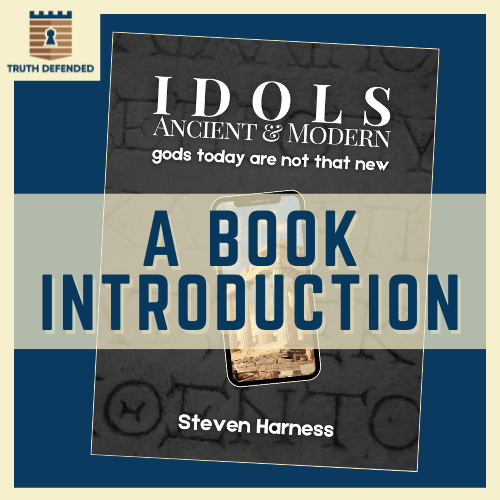
Below is the introduction to the newly anticipated book, “Idols: Ancient and Modern – the gods of today are not that new.” Would you be interested in purchasing and reading this book? Or sharing it with others? Please comment below.
Snares, traps, and pits. Humanity is prone to wandering and getting into a lot of trouble, falling into one of these danger zones. The danger zone of false deities and pagan idols abounds. Idol worship has existed since the Fall of man in the Garden of Eden. Humanity’s hearts and minds tend to easily wander away from God and towards false deities, sinful worldviews, and ideological idols. Our wandering is sometimes intentional, and at other times, it’s unintentional. While idol snares are many, and traps and pits are easy to fall into, there are many warnings in Scripture about avoiding these traps and instructions as to how to get out of idolatrous practices.
Recently, while reading Revelation 20, I noticed that the golden idol of the Antichrist demands that the people of the future fall to their knees and worship. Reading the verses below prompted me to investigate idols in the Bible further. The result of this investigation is the book you are reading.
And I saw thrones, and they sat upon them, and judgment was given unto them: And I saw the souls of them that were beheaded for the witness of Jesus, and for the word of God, and which had not worshipped the beast, neither his image, neither had received his mark upon their foreheads, or in their hands; and they lived and reigned with Christ a thousand years. But the rest of the dead lived not again until the thousand years were finished. This is the first resurrection (Revelation 20:4–5).
You can skip ahead to chapter nine to learn more about the Antichrist and the gold beast image that the people of the Tribulation worship, as found in Revelation 20. However, I recommend reading about the eight other ancient idols that are still a part of society and life today. Idols are not just ancient; they are modern as well. What has been worshipped in the past are the forerunners of the same things worshipped today. The gods of today are not that new.
Why a book about idols? Is idol worship really a problem in our world today? Why should I read a book about ancient idols? It’s not just that the idols of the past are old and forgotten. The idols of the past are alive in the minds of many in the world today. False gods are repackaged occasionally, and humanity worships them anew in each generation.
Just scroll through the headlines on a news app on your phone. Turn on the local or national news on your TV. Swipe through your social media feed. What do you notice? Pagan idols, evil or idolatrous worldviews, and other sinful behaviors that are indicative of idol worship. Its possible idol worship is at an all-time high today. With all the free time created with the use of tremendous technology today, we have more potential for sin and idol worship. Perhaps an adaptation of the old saying, “Idle hands are the devil’s workshop,” as a play on words, could be, “Idle hands create idol worship.” God is serious about the sinfulness of idols. He offers many Old Testament passages that warn against idolatry. Here are three examples.
- “For they provoked him to anger with their high places, and moved him to jealousy with their graven images” (Psalm 78:58).
- “I am the Lord: that is my name: And my glory will I not give to another, Neither my praise to graven images” (Isaiah 42:8).
- “Son of man, these men have set up their idols in their heart, and put the stumblingblock of their iniquity before their face: should I be inquired of at all by them? Therefore speak unto them, and say unto them, Thus saith the Lord God; Every man of the house of Israel that setteth up his idols in his heart, and putteth the stumblingblock of his iniquity before his face, and cometh to the prophet; I the Lord will answer him that cometh according to the multitude of his idols; That I may take the house of Israel in their own heart, because they are all estranged from me through their idols. Therefore, say unto the house of Israel, Thus saith the Lord God; Repent, and turn yourselves from your idols; and turn away your faces from all your abominations” (Ezekiel 14:3–6).
Idol’s Defined
One evening, during a youth group session at our local church, I taught a group of teenagers. The handbook material from AWANA stated that when we sin, that particular sin is an idol. Book drop. Head tilt. This concept is monumental. When we succumb to temptation and sin wins in the moment, we are setting up that specific sin as our god. It’s a momentary idol.
In the book, We Become What we Worship, Gregory Beale suggests that idols become the teachers of those worshipping them and writes, “The maker and the worshipers believe a god speaks and teaches through the idol, in reality, there is only emptiness within the image. To “trust in” such idolatrous “handiwork” and to follow the teachings of an idol that is “a teacher of falsehood” is to go down the wrong path and follow the doctrines of demons, since demons inhabit idols.”[i] In his accurate assessment, anything one worships can become an idol, and this idol will certainly lead a person away from the Lord. All idols have demonic origins or inspiration that are antagonistic towards the God of the Bible.
Idols, graven images, icons, teraphim, and gods (with a lowercase “g”) are just a few terms for idols in Scripture. What exactly is an idol? Holman’s Men’s Daily Bible says, “An idol is something a person worships instead of God.”[ii] I’ll define it this way for this book: Idols are images, ideologies, or any item (s) that take the place of the One True God being supreme in one’s life. Notice a few examples from this definition.
Images are objects of worship made of wood, stone, or precious metals. “Graven Images” is sometimes used in Scripture to indicate a carved or chiseled image. It’s not the same as a cast metal image with heated metal. A Graven Image is an idol carved into wood or stone.[iii] At other times, the idol is a cast metal idol, where the metal is heated up and formed to create a molten image, such as a statue. The Golden Calf that Aaron made in Exodus 32 exemplifies a molten image. Often in Scripture, especially the Old Testament, an idol is an image or a statue. Even today, people covet the Oscars and participation trophies, and even if one does not physically bend down to it, one’s life is bent toward doing what is required for these statues.
Ideologies are the idols of the mind, shaping one’s worldview. These ideologies also adopt a priority-based perspective. What we give our time, attention, and money to are often idols in one’s life. Fred Smith concisely says, “Worldviews are not systematic, nor even always conscious. They are ‘perceptual frameworks’ or ‘ways of seeing.’ We often assume the truth of our own worldview without carefully examining it. Worldviews include philosophies, and even theologies, but are not identical with them.”[iv]
Items are objects of worship, not confined to wood, stone, or metal objects. Items some worship include money, sex, addictions, relationships, sports, and other things. Some of these items are certainly not sinful in themselves, but once hoisted to the pinnacle of one’s life, these things and activities can become objects of worship that are related to a false god, a pagan idol. When I was a teenager, baseball was my idol. I gave a lot of time, thought, and effort to a leather-stitched ball. Behaviors, objects, and addictions are considered idols that are items.
Whether it’s an image, ideology, or item, an idol must be recognized as sinful and rejected. Ezekiel did not mince words when he encountered idols. He called them “dung deities.” Using the analogy of the useless nature of human excrement, Ezekiel highlights the worthless nature of false gods. Beale adds, “The idol is whatever claims the loyalty that belongs to God alone.”[v] May the Lord help each reader and disciple not to be led astray chasing after an idol.
Some of the idols overlap in form. Syncretism is undoubtedly a factor in the creation of several of these idols. Syncretism is “A systematic attempt to combine, blend and reconcile inharmonious, even often conflicting, religious elements’[vi] This phenomenon of mixing idols and components of idol worship will be observed and noted.
What is Old Is New
“There is nothing new under the sun” is profound and timeless wisdom from Solomon, undoubtedly relevant to the study of idols. While an image, ideology (worldview), or item of worship may be new to me or you, it is not new to this world. Many images, ideologies, items, and the like have been worshipped, prioritized, and served for millennia. Even King Solomon, with all his wisdom, was led astray by the many pagan gods his many foreign wives introduced to him (1 Kings 11:4-8). Being deceived and following a false god is preventable, but it requires more than just head knowledge. Solomon knew a great deal and possessed much wisdom, but his heart was led astray. One must commit one’s heart and mind to the Lord alone (Matthew 4:10). What led Solomon and others astray remains relevant and enticing to humanity today.
Primarily moving from the front of the Bible in Genesis through the last book, Revelation, this book focuses on the primary idols of images, ideology, and items that misguided people in ancient times. Starting with Humanism, we’ll explore the sky and Astrology, followed by the god of human sexuality in chapter three. From there, we will examine witchcraft and the unlikely god of religion, followed by the unknown idols that people search for. Then chapter seven speaks to the American idol of individualism, followed by Mother Earth, and rounding things out, we will look into the future at the Spirit of Antichrist.” One does not need to look far to see that ancient idols from years past are still prevalent in society today. I present to you “Idols: Ancient and Modern.”
Please drop a comment in the comment section!
[i] Beale, G K. We Become What We Worship: A Biblical Theology Of Idolatry (pp. 69-70). IVP. Kindle Edition, 2008.
[ii] Men’s Daily Bible, Holeman Bible Publishers, 2024. Brentwood, TN. Page 1461.
[iii] Edward M. Curtis, “Graven Image,” ed. David Noel Freedman, The Anchor Yale Bible Dictionary (New York: Doubleday, 1992), 1089.
[iv] C. Fred Smith, Developing a Biblical Worldview: Seeing Things God’s Way (Nashville, TN: B&H Academic, 2015), 2.
[v] Beale, G K. We Become What We Worship: A Biblical Theology Of Idolatry (p. 17). IVP. Kindle Edition.
[vi] Sunand Sumithra, “Syncretism, Secularization and Renewal,” in The Church in the Bible and the World: An International Study, ed. D. A. Carson (World Evangelical Fellowship, 1987), 262.


Leave a reply to kimberly1969 Cancel reply