
What is Dispensationalism?
How has God communicated with people throughout history? Of course, the Bible, or God’s Word, is the answer, but in what ways has God conveyed His word and message to humanity? What was the primary message? In Theology, a concept described throughout the Bible conveys how God has worked and spoken in different eras or ages.
The word “dispensation” appears four times in the New Testament and is described throughout the Bible. Dispensation (oikonomia) is understood to mean stewardship, administration, and management. It is “the management of a household or of household affairs; specifically, the management, oversight, administration, of others’ property; the office of a manager or overseer, stewardship: Lk. 16:2–4; hence Paul transfers the word in a theocratic sense to the office (duty) entrusted to him by God (the lord and master) of proclaiming to men the blessings of the gospel, 1 Co. 9:17.”[1] God oversees and administrates in the affairs and business of the earth, and we are part of His earth.
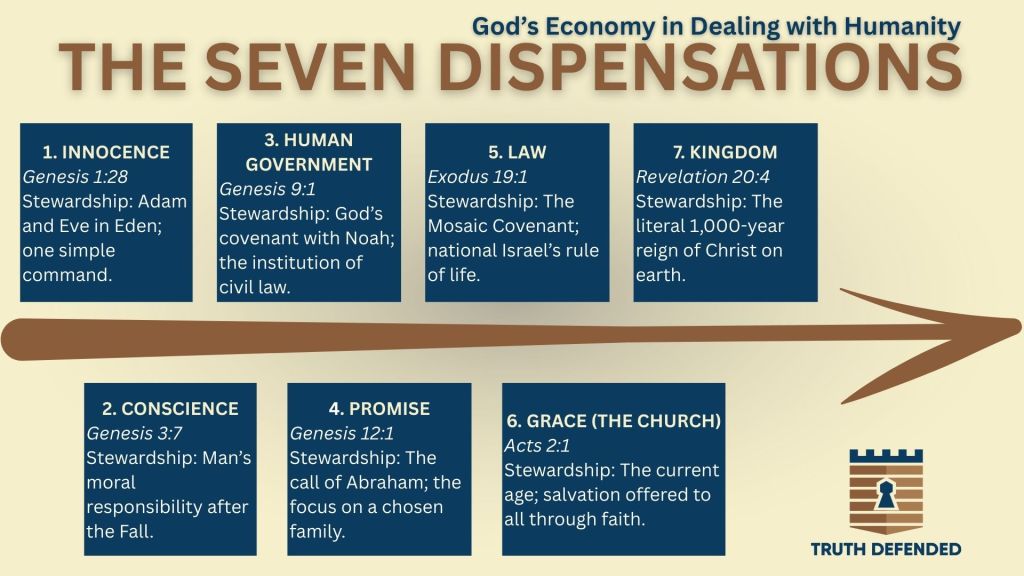
Theologian Charles Ryrie defines dispensationalism this way: A dispensation is a distinguishable economy in the outworking of God’s purpose.[2] This definition, along with the Greek definition, provides insight into how God is working and has worked in the lives of people throughout history, conducting His interaction in “His economy.” The matter is not so much how we relate to God, but how He has chosen to relate to humanity at various points in history. Please see the chart on this page for an overview perspective of the seven primary dispensations. “Economy” is not a financial term here, but a system in which one lives.
The Apostle Paul shares a doctrinal reality that the Gentiles (non-Jews) have a specific time frame in which God is working with them. “That in the dispensation of the fullness of times he might gather together in one all things in Christ, both which are in heaven, and which are on earth; even in him” (Ephesians 1:10). There is a “fullness of times” after which the nation of Israel and the Hebrews will once again be God’s representatives to earth. For the moment, this “Age of Grace or Church Age” is the era we are living in.
Three more New Testament references use the word “Dispensation” specifically.
- 1 Corinthians 9:17, “For if I do this thing willingly, I have a reward: but if against my will, a dispensation of the gospel is committed unto me.”
- Ephesians 3:2, “If ye have heard of the dispensation of the grace of God which is given me to you-ward.”
- Colossians 1:25, “Whereof I am made a minister, according to the dispensation of God which is given to me for you, to fulfil the word of God.”
- In each of these verses, God is working with a person or group on this timeline, timetable.
A Short History
The concept of dispensations is found throughout the Bible, but some believe it’s a newer idea. Theologians such as CI Scofield and John Darby were promoters of it in their generation. However, it’s much older than that. Early Church Fathers like Justin Martyr and Irenaeus (2nd Century) wrote about different “economies” or “dispensations” in God’s dealings with man.[3] Articulating 7 distinct dispensations is new (see the chart), but Bible readers have known of the economy of God since the beginning of the Scriptures. Instead of seven, I would contend the eighth could be “Eternity.” Beyond the Millennial Kingdom, God creates a new heaven and new earth in which we live with God forever (Revelation 21).
Jesus uses the term “Stewardship” in Luke 16:1-4, and it’s the same Greek word as “dispensation.” Here, the rich man in the parable has a manager who mismanages or poorly administers the wealth entrusted to him. The steward recovers some of what has been lost, demonstrating initiative. The Lord commends his economy and the way he handled the situation. In the same way, this parable tells of how the steward was managing or overseeing, God also manages the economy of this world. God has a system and a method in His work towards humanity.
Further back, one can see God administering or overseeing in specific ways in distinct periods of time. Examples include Adam and Eve, Noah, and Moses. Adam and Eve were innocent, and God dealt with them in the Garden of Eden differently before they sinned. After sin, they have a conscience, and God guides them into a new era that now includes sickness and death. Noah delivered the only believers of his day through the flood and God’s judgment, and God subsequently rebuilt humanity and the world after the devastating flood. Moses receives the Law on Mount Sinai, and God begins to deal with humanity with the measuring rod of the Law. Other examples can be seen on the dispensation chart.
There is “Neither Jew nor Greek”
A common question arises from Galatians 3:28, which says: “There is neither Jew nor Greek… for ye are all one in Christ Jesus.” Critics often suggest this “erases” the distinction between Israel and the Church. The dispensationalist responds with two key distinctions:
- Positional Equality vs. Functional Role
In Galatians, Paul is discussing Justification (how one is saved). In the “Dispensation of Grace,” there is no “VIP section” for Jews. All come to God through the same door: Christ. However, Paul also says there is “neither male nor female.” While men and women are positionally equal in Christ, they still retain distinct biological and functional roles in marriage and the Church as found in Ephesians 5. “One in Christ” refers to our standing before God, not the deletion of God’s separate, earthly plans for nations and ethnicities. Male and female distinctions and national heritages are still valid and important parts of our human experience – as God designed them to be.
2. Two Seeds, Not One
Some use Galatians 3:29 to suggest that the Church and the Hebrews are the same. Paul writes, “If ye be Christ’s, then are ye Abraham’s seed.” Dispensationalism clarifies that Abraham has two types of descendants: The Spiritual Seed: all believers who share Abraham’s faith (The Church, including both Messianic Jews and Gentiles who trust in Jesus only). The Physical Seed: The literal descendants of Jacob (Natural Descendants). These are the ones with Semitic blood coursing in their body.
While the Church inherits the spiritual blessings of Abraham, they do not “take over” the physical land promises of Genesis 15, nor does the Church inherit the throne promises of 2 Samuel 7 made specifically to the physical seed of Abraham. The Church does not replace Israel, nor are they merged on this earth. Before God, once in Heaven, we are all “one with Christ.” Still, until the Rapture and the eternal gathering, nations remain distinct, and the Church functions as God’s representative in this era, or “dispensation of grace,” otherwise known as the “church age.”
Today, God continues to communicate to us through His Word. The Bible speaks to our times and to our sinful condition, and extends hope by offering His grace to each who would receive it. While the Church represents God to this world, it’s apparent that God is thawing Israel out. It’s like they have been frozen for many years and are now about to awake to God. The Jewish state of Israel is physically in the land, but they have not been spiritually revived – yet. Ezekiel 37 could happen at any time, but when it does, the dispensational view is that the Church has been removed (the Rapture), and the Hebrews become God’s representatives to the nations, just as there were in the Old Testament. Some who do not see dispensationalism have several misconceptions about peace on earth, the Rapture, and the Millennial Kingdom. A dispensational view sees God working in specific stages and sees prophecy through the lens of Jesus, who is the only One who can make things right in this world.
Some practical considerations for the reader include reading the Bible and searching for how God dealt with different people throughout history. Use the chart to find a systematic approach to dispensationalism. Be thankful for God’s grace. Participate in church life. One day, your Church will not be there. Make the most of this Age of Grace we are in by faithfully serving the Lord today.
[1] Joseph Henry Thayer, A Greek-English Lexicon of the New Testament: Being Grimm’s Wilke’s Clavis Novi Testamenti (New York: Harper & Brothers., 1889), 440.
[2] Charles C. Ryrie, Dr. Ryrie’s Articles (Bellingham, WA: Logos Bible Software, 2010), 34.

Leave a comment